Knowledge Vault
The knowledge vault is an Obsidian-based persistent memory layer at .ai-brain/. It stores goals, decisions, reports, and reference knowledge that survives across conversations. Agents read from and write to the vault through the brain skill, and semantic search is provided by the obsidian-rag MCP server.
Vault Structure
.ai-brain/
├── 00-inbox/          # Landing zone — daily briefings and new notes
├── 01-goals/          # Quarterly objectives with key results
├── 02-projects/       # Project monitoring configs (repos, briefing checks)
├── 03-knowledge/      # Durable reference material (OSDU docs, architecture)
├── 04-reports/        # Generated reports (QA, dependencies, incidents)
├── attachments/       # Images, diagrams, embedded files
└── templates/         # Note templates (read-only)
| Folder | Contents | Lifecycle |
|---|---|---|
00-inbox | Daily briefing notes, unprocessed items | Created daily, promoted or archived |
01-goals | Quarterly OKRs, key results tracking | Updated weekly/monthly |
02-projects | Repo lists, monitoring configs, briefing rules | Updated when project scope changes |
03-knowledge | OSDU platform docs, architecture decisions, standards | Long-lived, updated when sources change |
04-reports | QA reports, dependency scans, incident RCAs | Created per event, reference only |
Note Types and Templates
Templates live in .ai-brain/templates/ and define the structure for each note type:
| Template | Used For | Created By |
|---|---|---|
daily-note.md | Morning briefing output | Wingman (briefing skill) |
decision-record.md | Architecture Decision Records | Any agent (brain skill) |
decision.md | Lightweight decisions (non-ADR) | Any agent (brain skill) |
qa-report.md | Test reliability analysis | OSDU agent |
dependency-report.md | Dependency scan results | OSDU agent |
incident-report.md | Outage/issue RCA | Any agent |
goal.md | Quarterly objective + key results | Wingman |
architecture-note.md | System design documentation | Any agent (learn skill) |
report-note.md | General structured report | Any agent |
meeting-note.md | Meeting minutes and action items | Wingman |
Write Discipline
Agents follow strict rules about what goes into the vault:
| Write To Vault | Keep In Chat |
|---|---|
| Decisions with long-term impact | Ephemeral debugging output |
| Reusable knowledge (distilled from sources) | Raw API responses |
| Reports that will be referenced later | One-time analysis |
| Goals and key results | Conversation-specific context |
| Daily briefing summaries | Intermediate work products |
The brain skill enforces these boundaries. Agents never write directly to vault files — they always go through the brain skill protocol, which validates content and applies the correct template.
MCP Integration
The obsidian-rag MCP server provides semantic search over the vault. Configured in .copilot/mcp-config.json:
{
  "mcpServers": {
    "obsidian-rag": {
      "command": "bash",
      "args": ["-c", "source .ai-wingman/.env && obsidian-rag serve --vault .ai-brain"],
      "env": {}
    }
  }
}
Available Tools
| MCP Tool | Purpose |
|---|---|
search_vault | Semantic search across all vault notes |
get_note | Retrieve a specific note by path |
search_by_tag | Find notes with specific Obsidian tags |
get_related | Find notes related to a given note |
list_recent | List recently modified notes |
search_with_reasoning | Semantic search with explanation of relevance |
explore_connected_conclusions | Traverse linked conclusions across notes |
get_conclusion_trace | Trace the reasoning chain for a conclusion |
index_status | Check vault indexing status |
How Agents Use MCP
Agents query the vault before starting work to gather relevant context:
- Wingman searches for goals and prior decisions before making recommendations
- OSDU agent searches for past QA reports before analyzing test results
- Base copilot searches for architecture decisions before suggesting changes
Knowledge Flow
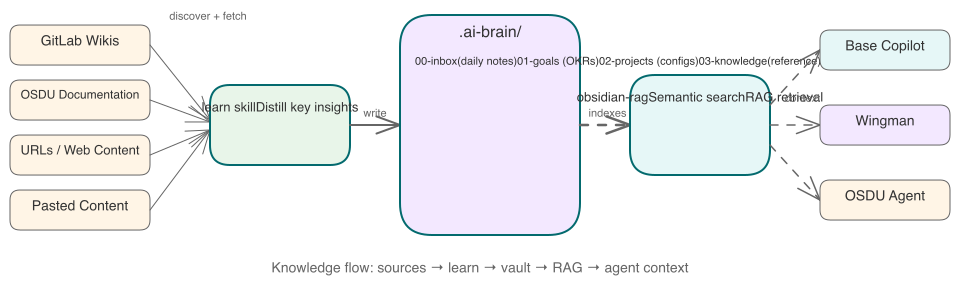
Knowledge moves through the system in a defined pipeline:
| Stage | Action | Tool |
|---|---|---|
| Discover | Identify external sources (GitLab wikis, docs, URLs) | learn skill |
| Fetch | Retrieve raw content | learn skill + web tools |
| Distill | Extract key insights, remove noise | learn skill |
| Write | Create vault note with proper template | brain skill |
| Index | MCP server re-indexes vault content | obsidian-rag (automatic) |
| Retrieve | Agents search vault for relevant context | MCP tools |
Example: Learning from OSDU Documentation
User: "Learn about the OSDU Partition service from the wiki"

1. learn skill → fetches GitLab wiki pages for os-partition
2. learn skill → distills: API endpoints, data model, dependencies
3. brain skill → writes to 03-knowledge/osdu-partition.md
4. obsidian-rag → re-indexes, note available for future searches
5. Next conversation → agent finds partition context automatically
Vault Maintenance
The vault is designed to be low-maintenance:
- Scaffolding is version-controlled — folder structure and templates live in the repo
- Content is gitignored — actual notes are local to each developer's machine
- Reindexing is automated — MCP server watches for file changes
- Stale notes decay naturally — daily notes accumulate but don't need cleanup
- Knowledge notes are updated — the
learnskill updates existing notes when sources change
See also
- Skills & Commands — the
brainandlearnskills that manage vault content - Agents — how each agent uses the vault for context
- Developer Workflows — workflows that read from and write to the vault