Traffic & Routing
This page documents how traffic flows through the platform — from external requests entering the cluster to internal service-to-service communication and async event processing.
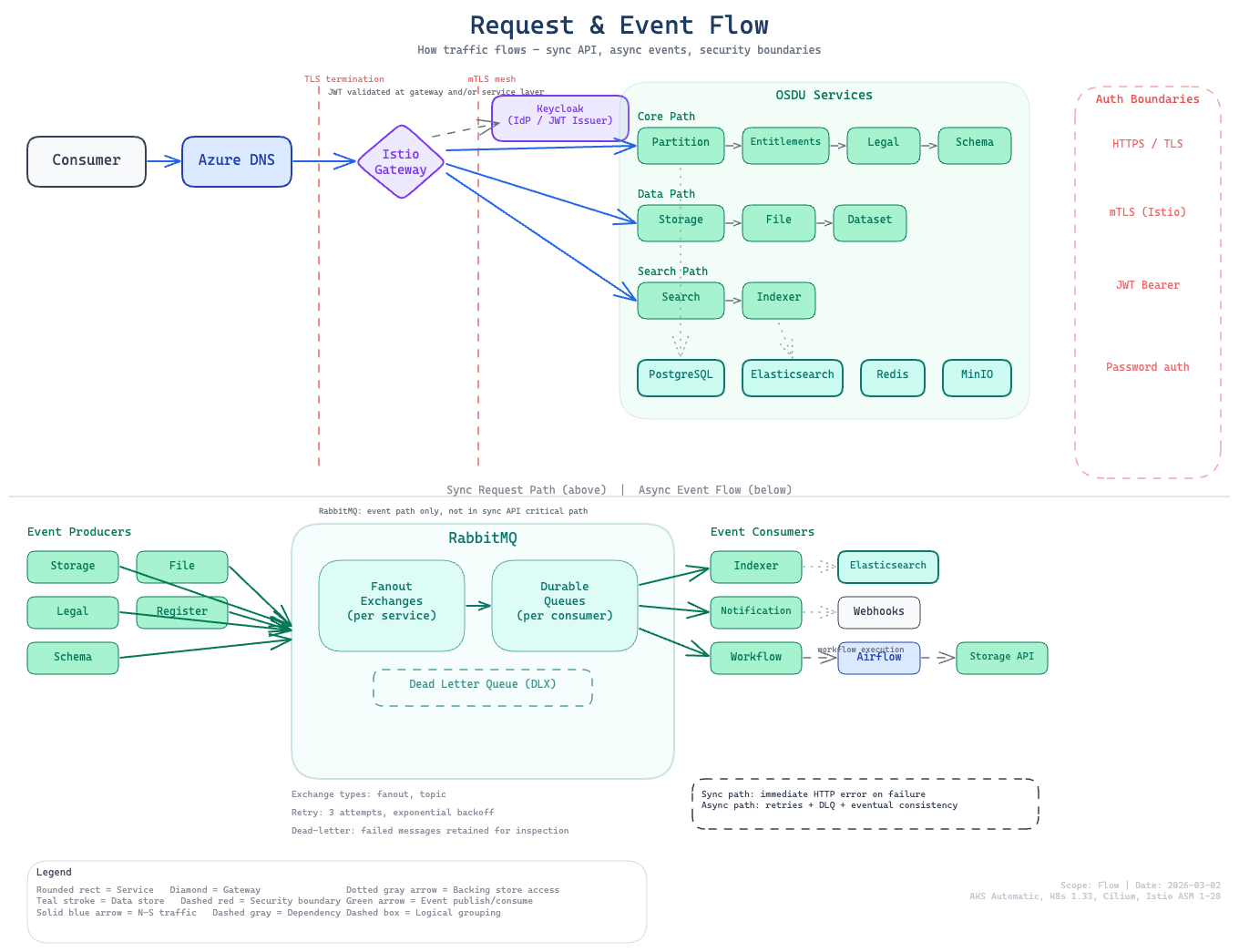
External Traffic Path
External requests enter the cluster through Istio's ingress gateway, are matched by Gateway API HTTPRoute rules, and are forwarded to backend services with TLS termination at the gateway.
DNS Resolution
Each exposed service gets a hostname derived from the ingress prefix:
| Endpoint | Hostname Pattern |
|---|---|
| OSDU API | {prefix}.{dns_zone_name} |
| Kibana | {prefix}-kibana.{dns_zone_name} |
| Keycloak | {prefix}-keycloak.{dns_zone_name} |
| Airflow | {prefix}-airflow.{dns_zone_name} |
The ingress prefix (CIMPL_INGRESS_PREFIX) is auto-generated during pre-provision if not set. DNS records are created either manually or via ExternalDNS once its identity and DNS zone access have both been bootstrapped.
TLS Certificates
cert-manager provisions Let's Encrypt certificates for each HTTPRoute hostname. Certificates are stored as Kubernetes Secrets and referenced by the Gateway resource. The HTTP-01 challenge solver uses the Istio Gateway for validation.
See Platform Services — cert-manager for full configuration details.
Gateway API
Modern ingress routing using Kubernetes Gateway API with Istio as the implementation.
Architecture
| Component | Resource | Purpose |
|---|---|---|
| Gateway | Gateway in aks-istio-ingress | External Istio ingress with Azure Load Balancer |
| Routes | HTTPRoute per endpoint | Path-based and host-based routing rules |
| TLS | Certificate per hostname | cert-manager provisions Let's Encrypt certificates |
| Access | ReferenceGrant per namespace | Allow cross-namespace secret references |
HTTPRoute Pattern
Each external endpoint is defined as an HTTPRoute that matches on hostname and forwards to the backend service:
apiVersion: gateway.networking.k8s.io/v1
kind: HTTPRoute
metadata:
  name: osdu-api
  namespace: osdu
spec:
  parentRefs:
    - name: gateway
      namespace: aks-istio-ingress
  hostnames:
    - "myprefix.example.com"
  rules:
    - matches:
        - path:
            type: PathPrefix
            value: /api/partition/
      backendRefs:
        - name: partition
          port: 80
Public vs Internal Ingress
The enable_public_ingress flag controls whether the gateway gets an external or internal Azure Load Balancer IP:
- Public (default): Internet-reachable endpoints with Let's Encrypt TLS
- Internal: Accessible only within the VNet; useful for private deployments
Cross-Namespace ReferenceGrants
Gateway API requires explicit ReferenceGrant resources to allow HTTPRoutes in the osdu or platform namespaces to reference the Gateway in aks-istio-ingress. The gateway module creates these grants automatically for each enabled endpoint.
Internal Service Communication
OSDU Service-to-Service (mTLS)
All OSDU services in the osdu namespace communicate over Istio's mTLS mesh:
- mTLS mode: STRICT (enforced by
PeerAuthenticationin theosdunamespace) - Service discovery: Kubernetes DNS (e.g.,
partition.osdu.svc.cluster.local:80) - K8s Service port: 80 (targetPort 8080 on the pod)
See Security — Istio mTLS for policy details and sidecar opt-outs.
Middleware Access (Cross-Namespace)
OSDU services in the osdu namespace reach middleware in the platform namespace via standard Kubernetes DNS:
| Middleware | Endpoint | Port |
|---|---|---|
| PostgreSQL (read-write) | postgresql-rw.platform.svc.cluster.local | 5432 |
| PostgreSQL (read-only) | postgresql-ro.platform.svc.cluster.local | 5432 |
| Elasticsearch | elasticsearch-es-http.platform.svc.cluster.local | 9200 |
| Redis | redis-master.platform.svc.cluster.local | 6379 |
| RabbitMQ | rabbitmq.platform.svc.cluster.local | 5672 |
| MinIO | minio.platform.svc.cluster.local | 9000 |
| Keycloak | keycloak.platform.svc.cluster.local | 8080 |
Note
Both the platform and osdu namespaces have Istio sidecar injection enabled with STRICT mTLS. Cross-namespace calls between them stay within the mesh. A few pods in the platform namespace (e.g., RabbitMQ) opt out of sidecar injection at the pod level; calls to these pods use application-layer security (password auth).
Async Event Flow
RabbitMQ Messaging
OSDU services use RabbitMQ for asynchronous event processing:
| Producer | Exchange | Consumer | Purpose |
|---|---|---|---|
| Storage | storage | Indexer | Record create/update triggers index refresh |
| Various | notification | Notification service | Downstream event delivery |
| Workflow | workflow | Airflow | DAG run triggers via message queue |
Connection Details
| Setting | Value |
|---|---|
| Host | rabbitmq.platform.svc.cluster.local |
| Port | 5672 |
| Credentials | From rabbitmq-secret |
Data Storage Patterns
OSDU services use three storage backends, each serving a different access pattern:
| Backend | Used For | Access Pattern | Endpoint |
|---|---|---|---|
| PostgreSQL | Structured data (OSM) | JDBC per-service database | postgresql-rw.platform:5432/{db} |
| Elasticsearch | Full-text search + analytics | REST API via Indexer/Search | elasticsearch-es-http.platform:9200 |
| MinIO | Binary objects (files, datasets) | S3 API | minio.platform:9000 |
PostgreSQL (OSM)
Each OSDU service stores structured data in its own database within the shared CNPG cluster. The OSM pattern uses: id text (record ID), pk bigint IDENTITY (auto-increment), data jsonb NOT NULL (document), plus a GIN index on data for JSON path queries.
Elasticsearch (Search & Analytics)
Indexer maintains Elasticsearch indices for full-text search. When Storage creates or updates records, it publishes events to RabbitMQ. Indexer consumes these events and updates the corresponding Elasticsearch indices. The Search service queries these indices directly.
MinIO (Object Storage)
File and Dataset services store binary objects in MinIO via the S3 API. Objects are organized into buckets per data partition.
See also
- Platform Services — middleware component details (Elasticsearch, PostgreSQL, Redis, etc.)
- Security — Istio mTLS policies and authentication flows
- Service Architecture — how OSDU services are deployed and configured